How to interview an elderly person
The stories that matter most rarely arrive on schedule. A woman in her forties sat down with her 87-year-old father expecting to hear about his career. Instead,…
· 19 min read · by Autobiographai
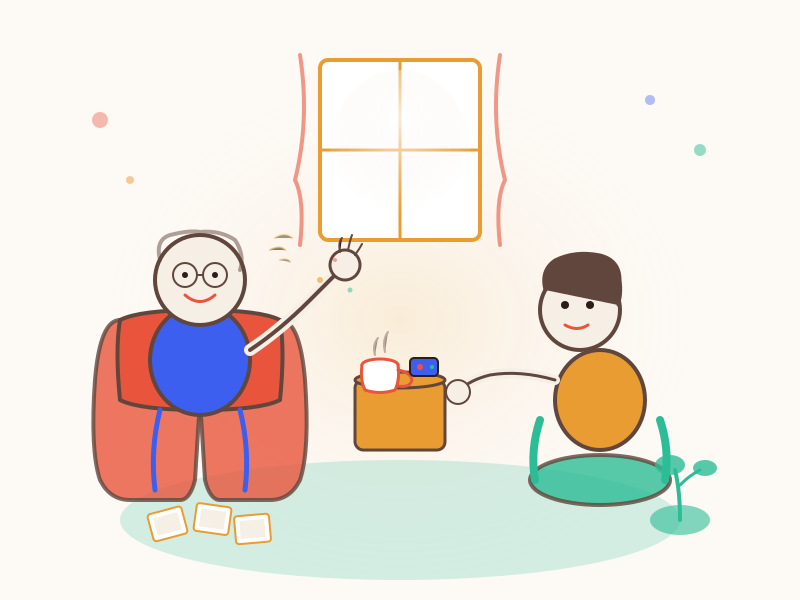
The stories that matter most rarely arrive on schedule. A woman in her forties sat down with her 87-year-old father expecting to hear about his career. Instead, he spent two hours describing the summer he was twelve, working on his uncle's farm. That summer, she learned later, was when his own father died. This is the nature of interviewing elderly relatives: the conversation you prepare for is almost never the conversation you get. Learning how to interview an elderly person requires understanding that memory, emotion, and physical stamina work differently after seven or eight decades of life. Whether you're starting a family oral history project or simply want to capture your grandmother's voice before it fades, the approach matters as much as the questions. A life story interview with someone in their eighties differs fundamentally from any other kind of conversation. The techniques for recording family history that work with younger subjects often fail completely with older ones. And the oral history interview questions that seem obvious on paper frequently fall flat in practice. What follows is a guide built from the accumulated experience of biographers, oral historians, and families who have done this work, and done it well.
Why interviewing an elderly person requires a different approach
The interview you imagine and the interview that happens will be two different things. Accepting this from the start saves frustration and opens space for what actually emerges.
Memory works differently after seventy
The brain at eighty is not a failing version of the brain at forty. It operates by different rules. Long-term memories, particularly those encoded with strong emotion, often remain remarkably vivid. Your grandmother may not remember what she had for breakfast, but she can describe the wallpaper in her childhood bedroom in startling detail.
This pattern has practical implications for elderly interview techniques. Questions about recent events often produce frustration and embarrassment. Questions about the distant past, especially those tied to sensory experience or emotional intensity, tend to unlock rich material. The summer of 1952 may be more accessible than last Tuesday.
Repetition is normal. An elderly person may tell the same story three times in one conversation, sometimes with slight variations. Each telling often reveals something new. The variation itself can be meaningful, showing which details the person considers most important or most emotionally charged.
The emotional weight of revisiting the past
An eighty-year-old has lived through loss that a forty-year-old can barely imagine. Parents, siblings, spouses, friends, sometimes children. Asking someone to revisit their past means asking them to walk through a landscape populated by ghosts.
Some memories bring joy. Others carry grief that hasn't diminished in sixty years. The interviewer cannot predict which topics will trigger which response. A question about a favorite teacher might lead to tears. A question about the war might produce laughter and warmth.
The emotional weight doesn't mean avoiding difficult topics. It means approaching them with awareness that you're asking for something significant. The person across from you is not a historical source to be mined. They're offering a gift.
Building trust before pressing record
The recorder changes everything. Even a smartphone lying casually on the table creates a different dynamic than a private conversation. Some elderly people feel honored by the attention. Others feel scrutinized or performative.
Trust builds before the interview begins. Phone calls, visits, shared meals. The message, delivered through action rather than words, that this matters to you. That you're not checking a box or fulfilling an obligation, but genuinely want to hear what they have to say.
The first interview session often works best without any recording at all. A conversation that establishes the relationship, covers some preliminary ground, and lets the person get comfortable with the idea of being interviewed. The recording can wait for session two.
Physical considerations that shape the conversation
Hearing loss affects most people over seventy-five to some degree. Speaking clearly, facing the person directly, and minimizing background noise aren't just courtesies. They're prerequisites for a functional conversation.
Fatigue sets in faster than you expect. An hour of concentrated conversation exhausts many elderly people. Ninety minutes pushes the limit. Two hours is almost always too long. Better to plan multiple shorter sessions than one marathon that leaves everyone drained.
Time of day matters. Most older adults have more energy and mental clarity in the morning. Late afternoon often brings what caregivers call "sundowning," a decline in cognitive function as the day wears on. Schedule accordingly.
Comfort needs attention. A chair that hurts after twenty minutes will end the interview. Temperature matters. Access to water matters. The ability to take a bathroom break without embarrassment matters.
Preparing for the interview
Preparation separates productive interviews from frustrating ones. The work you do before pressing record shapes everything that follows.
Choosing the right time and place
The familiar environment wins almost every time. Your grandmother's living room, surrounded by objects that trigger memory, produces richer material than a neutral location. The photograph on the mantel, the chair her husband always sat in, the view from the window she's looked through for forty years: these become prompts without anyone having to prompt.
If the person lives in a care facility, their room still beats a common area. Privacy matters for the kinds of conversations that go deep.
Morning interviews tend to work better than afternoon ones. The mind is clearer, energy higher, patience longer. Avoid scheduling immediately after meals, when drowsiness often sets in.
Allow buffer time. Rushing an elderly person through pleasantries to get to the "real" interview damages the trust you need. Arrive early. Accept the offered tea. Look at the photographs on the wall. The interview begins before you think it does.
Equipment that stays out of the way
The best recording equipment is the equipment you forget is there. A smartphone with a decent voice recording app works for most purposes. Place it between you, not pointed at the interviewee like an accusation.
External microphones improve audio quality significantly but add complexity. For a first interview, simplicity usually wins. A phone recording in a quiet room captures enough.
Test everything before you arrive. Nothing kills momentum like spending the first fifteen minutes troubleshooting technology while your ninety-year-old grandmother waits patiently.
Bring backup. A second recording device, even just another phone, protects against the heartbreak of lost audio. Batteries die. Apps crash. Memory fills up.
Researching family history beforehand
The more you know going in, the better your questions become. Dates, places, names, relationships: these provide anchors for memory. "Tell me about your childhood" often produces a blank stare. "You lived on Maple Street until you were twelve, and then your family moved to Cleveland. What do you remember about leaving that house?" opens a door.
Gather what you can from other family members first. Look through old photographs. Review any documents, letters, or family records that exist. Build a rough timeline of the person's life.
This research also reveals gaps. You may discover that no one in the family knows where your grandfather was between 1943 and 1946. That gap becomes a question.
Creating a flexible question outline
Prepare questions, but hold them loosely. An interview with an elderly person rarely follows a predetermined path. The outline exists to ensure you don't forget important topics, not to dictate the conversation's flow.
Organize questions roughly chronologically, from childhood through the present. Within each period, move from concrete to reflective. What happened, then what it meant.
Leave space on your outline for notes. The answer to one question often suggests follow-up questions you couldn't have anticipated.
For those looking to go deeper into the art of these conversations, a detailed interview guide for parents and grandparents covers additional techniques specific to family dynamics.
Questions that unlock stories
The right question at the right moment opens decades of memory. The wrong question closes them. Learning to ask well is a skill that develops with practice.
Opening questions that ease into the conversation
Never start with the heavy questions. The first ten minutes establish rhythm and comfort. Begin with something concrete and relatively recent, then work backward.
Strong opening questions:
- What's the first thing you remember about this house?
- I saw that photograph on the mantel. Who are those people?
- What did you do this morning before I arrived?
These questions accomplish multiple things. They're easy to answer, which builds confidence. They're grounded in the present environment, which feels natural. And they often lead organically into the past.
Avoid beginning with "Tell me about your life" or "What's your earliest memory?" These questions are too big. They paralyze rather than prompt.
Questions about childhood and early life
Childhood memories often remain the most vivid and the most emotionally accessible. This territory tends to produce the richest material.
Concrete questions about daily life:
- What did your house look like? Can you describe your bedroom?
- What did you eat for breakfast as a child?
- How did you get to school?
- What games did you play?
Questions about family:
- What was your mother like when you were small?
- What did your father do for work?
- Did you have chores? What happened if you didn't do them?
- Who lived in your house besides your immediate family?
Questions about the wider world:
- What was your neighborhood like?
- Do you remember any news events from your childhood?
- When did your family get a radio? A telephone? A television?
Questions about work, love, and turning points
The middle decades of life often receive less attention in family oral histories, but they contain the choices that shaped everything after.
Questions about work:
- How did you decide what to do for a living?
- What was your first day at your first real job like?
- Who was the best boss you ever had? The worst?
- What did you learn from your work that you couldn't have learned anywhere else?
Questions about relationships:
- How did you meet your spouse?
- What was your wedding day like?
- What did you and your spouse argue about?
- What's the secret to staying married for fifty years?
Questions about turning points:
- Was there a moment when your life could have gone a completely different direction?
- What's the hardest decision you ever made?
- Did you ever move to a new place and start over?
Questions about values, regrets, and wisdom
These questions often produce the material that matters most to future generations. They require trust and usually come later in the interview or in subsequent sessions.
Questions about values:
- What do you believe that most people don't?
- What did your parents teach you that turned out to be true?
- What did they teach you that turned out to be wrong?
Questions about regret and difficulty:
- What do you wish you'd done differently?
- What was the hardest period of your life?
- Is there anything you've never told anyone?
Questions about wisdom:
- What do you know now that you wish you'd known at thirty?
- What advice would you give to someone starting out today?
- What matters less than people think? What matters more?
The one question most people forget to ask
After hours of oral history interview questions about the past, interviewers often neglect the question that ties everything together: What do you want your grandchildren to know about you?
This question shifts the frame. Instead of recounting history, the person becomes an author, choosing what to transmit. The answer often reveals what they consider most essential about their life, stripped of chronology and incident.
Ask it near the end of your final session. Give them time to think before answering.
Interview techniques that draw out deeper answers
The questions matter, but how you listen matters more. Elderly interview techniques differ from standard journalistic practice. The pace is slower. The silences are longer. The tangents are often where the treasure lies.
The power of silence
Most interviewers talk too much. They fill every pause with another question, nervous about dead air. With elderly subjects, this habit destroys the best material.
After someone answers a question, wait. Count to five silently. Often, the person will continue, adding detail or reflection they wouldn't have reached if you'd jumped in with the next question.
Silence communicates that you're not in a hurry. That whatever they say next is worth waiting for. That this conversation has room for them to think.
Following tangents without losing the thread
Your grandmother starts answering a question about her wedding and suddenly she's talking about her sister's dress, then her sister's husband, then the factory where he worked, then the strike of 1947.
This is not a problem. This is the interview working.
Tangents often lead to material you couldn't have reached through direct questions. The associative leaps of an elderly mind connect things in ways that reveal deeper patterns. Follow them.
Keep a mental note of where you were before the tangent began. When the tangent concludes naturally, you can gently return: "You were telling me about your wedding day..."
Using photographs and objects as prompts
A photograph unlocks memory more reliably than almost any question. The visual image triggers associations that verbal prompts cannot reach.
Bring old family photographs if you have them. Ask the person to identify people, places, occasions. "Who is this? Where was this taken? What was happening that day?"
Objects work similarly. A piece of jewelry, a tool, a letter, a book. Anything with personal history attached can become a doorway into story.
This technique is especially valuable for those interested in organizing family memories and photographs as part of a larger preservation project.
Handling emotional moments with care
Tears will come. Difficult memories surface. The person you're interviewing may become visibly distressed.
Do not panic. Do not immediately change the subject. Sit with them. A hand on their hand, if appropriate. A quiet "Take your time."
Often, the person wants to continue. The tears are part of the telling, not a signal to stop. Wait for them to indicate what they need.
Have tissues available. Have water available. These small preparations communicate that emotional responses are expected and acceptable.
When to gently redirect
Sometimes a tangent becomes a loop. The person returns to the same story repeatedly, unable to move forward. Sometimes a topic causes distress that doesn't resolve.
Gentle redirection: "That sounds difficult. I'd love to hear more about [earlier topic] when you're ready."
Never force a redirect. If someone needs to tell the same story three times, let them. The repetition itself may be meaningful.
For those working with parents or grandparents facing health challenges, questions specifically for aging or ill parents addresses the additional sensitivities involved.
Recording and preserving what you capture
The interview happened. The stories poured out. Now the technical work of preservation begins.
Audio versus video: making the right choice
Video captures expression, gesture, the physical presence of the person. Audio captures voice without the self-consciousness that cameras often create.
For most family interviews, audio works better. Elderly people often feel uncomfortable on camera, worried about how they look. The camera becomes a presence in the room that distorts natural conversation.
Video makes sense when visual elements matter. When the person demonstrates something, shows objects, or has particularly expressive mannerisms worth preserving.
If you choose video, keep the setup minimal. A phone on a small tripod, not a full production. The goal is to forget the camera is there.
For guidance on capturing voice specifically, recording a loved one's voice covers the technical and emotional dimensions in depth.
Backup strategies that prevent heartbreak
One copy is no copies. The horror stories of lost recordings, corrupted files, and crashed hard drives fill oral history forums.
The moment the interview ends, copy the recording to a second device. Upload it to cloud storage. Email it to yourself. Do all three.
Name files clearly: "Grandma_Rose_Interview_2024-03-15_Session2.mp3" beats "Recording_47.mp3" when you're searching through files years later.
Store copies in physically different locations. A hard drive and cloud storage. Your computer and your sister's computer. The goal is redundancy that survives any single point of failure.
Transcribing while memories are fresh
Transcription transforms audio into text that can be searched, quoted, and edited into other forms. The work is tedious but valuable.
Start transcription soon after the interview, while your memory of the conversation remains fresh. Unclear words, inside jokes, and references that seem obvious now will become puzzles later.
You don't need perfect transcription. A working document that captures the content is enough. Note timestamps for important passages so you can find the original audio.
Automated transcription services have improved dramatically. They produce rough drafts that require cleanup but save hours of typing.
| Transcription Method | Pros | Cons |
|---|---|---|
| Manual typing | Most accurate, catches nuance | Extremely time-consuming |
| Automated services | Fast, inexpensive | Requires significant cleanup |
| Professional transcriber | High quality, handles difficult audio | Expensive |
| Hybrid approach | Balances speed and accuracy | Requires some manual work |
Organizing recordings for future use
A system that works for three recordings will fail for thirty. Build organization habits from the start.
Create a folder structure by person and date. Keep a master log document that lists each recording with date, duration, topics covered, and notable moments.
Tag or note the locations of particularly important passages. "Grandma talks about leaving Poland at 47:23" saves future searchers enormous time.
Consider who else might need access. Shared cloud folders allow family members in different locations to access the archive. Clear naming conventions help everyone find what they need.

Turning interviews into lasting family documents
Raw recordings serve preservation. Finished documents serve transmission. The stories you captured deserve a form that future generations will actually engage with.
From raw recording to written narrative
The jump from hours of audio to readable prose intimidates many people. The key is accepting that you're not transcribing, you're transforming.
Written narrative condenses, reorganizes, and clarifies. The story your grandmother told across three sessions, with repetitions and tangents, becomes a focused chapter that captures the essence.
Preserve the voice. The goal isn't to make your grandmother sound like a professional writer. It's to capture how she actually spoke while making the text readable.
This is where Autobiographai can help. The AI biographer takes recorded memories and transforms them into structured narrative, preserving voice while creating readable prose. The technology handles the organization and formatting while the human stories remain central.
Creating a family memory book
A book gives stories physical permanence. Something that can be held, passed around a table, discovered in an attic decades later.
The simplest approach: printed pages in a binder. More polished: a professionally printed photo book with text and images integrated. Most elaborate: a hardcover book with professional design.
Match the format to your audience and resources. A spiral-bound collection of transcribed stories serves the purpose. A coffee-table book makes a statement.
For those interested in combining photographs with narrative, creating an illustrated photo memoir provides detailed guidance on the process.
Sharing recordings across generations
Not everyone will read a book. Some family members prefer to hear the original voice.
Create accessible versions of key recordings. Edited highlights, cleaned-up audio, perhaps with brief introductions explaining context. Share these through family group chats, cloud links, or USB drives at reunions.
Consider preserving your grandparents' voices as a specific project, creating audio files that future generations can listen to even after the speakers are gone.
When to consider professional help
Some projects exceed what one person can reasonably accomplish. Professional help makes sense when:
- The volume of material overwhelms available time
- The stories involve complex historical context requiring research
- The family wants a polished final product
- Technical challenges exceed personal skills
- The emotional weight of editing makes it difficult to proceed
A professional biographer brings experience in structuring narrative, interviewing techniques, and producing finished documents. Autobiographai offers an alternative path, using AI to guide the process while keeping costs lower than traditional biography services. The guided questions help draw out stories decade by decade, and the resulting book includes original illustrations that bring the narrative to life.
The interviews you've conducted contain irreplaceable material. Whatever form the final document takes, the work of preservation matters.
Related articles
- Theme
Writing memoirs for family
Most families believe their history will survive on its own. Photographs get passed down, names get repeated at holiday tables, and the assumption persists that…
Writing memoirs for grandchildren
Writing memoirs for grandchildren is one of the most meaningful acts of love a grandparent can undertake. You have lived through decades that your grandchildren…
How to write a family saga
Every family carries stories that exist nowhere else. The way your grandmother described her village before the war. The reason your father never spoke about hi…
How to interview parents about their life
Most families carry stories that will disappear within a generation. The details of how your grandparents survived the war, what your mother dreamed of becoming…
- Theme
Questions to ask your parents
Most people assume they have time. Time to sit down with their parents over coffee, time to ask about the stories they've only half-heard, time to finally recor…
Ready to write your autobiography?
The stories that matter most rarely arrive on schedule. A woman in her forties sat down with her 87-year-old father expecting to hear about his career. Instead,…
Start