How to ask parents about their past
You've tried before. You sat down with your mother, maybe during a quiet afternoon, and asked her how to ask parents about their past without making it feel lik…
· 19 min read · by Autobiographai
You've tried before. You sat down with your mother, maybe during a quiet afternoon, and asked her how to ask parents about their past without making it feel like an interrogation. "What was it like growing up?" you said. She paused, looked somewhere past your shoulder, and answered: "It was fine." Two words. Then silence. You tried again with your father. "Tell me about your childhood." He shrugged. "There's not much to tell." The conversation moved on to weather, to what's for dinner, to anything but the stories you actually wanted to hear. This frustration is universal. Getting parents to open up about their lives requires more than good intentions. The usual conversation starters with parents often backfire because they put people on the spot, ask for summaries of experiences too vast to summarize, or trigger emotional territory your parent isn't ready to enter. Learning how to talk to parents about family history means understanding why direct questions fail, and then finding ways to get parents to share stories through approaches that feel less like interviews and more like natural family conversations. What follows are practical techniques that work, tested across generations and family dynamics.

Why direct questions often fail
The interrogation effect and how it shuts people down
Picture your parent sitting across from you. You lean forward, ask a meaningful question about their past, and wait. What happens in their mind? For many people, especially those who didn't grow up discussing feelings, this moment creates immediate pressure. They're being asked to perform. To retrieve something significant. To deliver a worthy answer.
This is the interrogation effect. Even when your intentions are loving, the structure of a direct question can feel like being put on the spot. Your parent might freeze, unable to access memories that would flow freely in a different context. They might deflect with humor or brevity. They might feel, without quite knowing why, that whatever they say won't be good enough.
The broader the question, the worse this effect becomes. "What was your life like?" demands a summary of decades. "Tell me about your parents" requires organizing a lifetime of complicated feelings into something coherent. The mind recoils from the task.
Generational differences in talking about feelings
Your generation grew up with therapy as a mainstream concept, with social media encouraging personal narrative, with the assumption that talking about experiences is healthy and normal. Your parents' generation often did not.
Many people who lived through the mid-twentieth century were raised in households where emotions stayed private. Discussing difficulties meant burdening others. Reflecting out loud felt self-indulgent. The cultural message was clear: you dealt with things quietly, you moved forward, you didn't dwell.
This doesn't mean your parents lack rich inner lives or meaningful memories. It means the muscle for articulating those memories out loud was never developed. When you ask them to suddenly exercise it, the discomfort isn't about you or your question. It's about a lifetime of practice in not doing exactly what you're asking them to do.
When parents don't think their stories matter
"Nothing interesting ever happened to me." How many times have you heard some version of this? Your parent genuinely believes their life was ordinary, unremarkable, not worth recording.
This belief runs deep. They compare their experiences to what they've seen in books and films. Their childhood wasn't dramatic enough. Their career wasn't distinguished enough. Their struggles weren't unique enough. They've internalized a standard of what makes a life "worth telling" and concluded they don't meet it.
What they don't understand is that the specific texture of an ordinary life is precisely what becomes precious to future generations. The way the kitchen smelled on Sunday mornings. The route they walked to school. The small rituals of a household that no longer exists. These details, which feel mundane to them, are irreplaceable to you.
The weight of questions that feel too big
Some questions carry invisible weight. "What was your father like?" might seem simple, but for your parent it might summon decades of complicated feelings, unresolved grief, old anger, or love too deep to articulate quickly.
When you ask about the past, you're often asking about relationships that shaped your parent in ways they've never fully examined. The question lands not as curiosity but as an invitation to process things they've successfully avoided processing for fifty years.
No wonder they deflect. No wonder they give you nothing. The question isn't too small. It's too big.
Using objects and photographs as conversation anchors
The power of holding something physical
Memory works differently when the hands are involved. A photograph held between fingers. A kitchen tool turned over to examine the worn handle. A piece of jewelry lifted from a box. The physical object creates a bridge between present and past that words alone cannot build.
When you put something tangible in front of your parent, you change the dynamic entirely. They're no longer being asked to retrieve memories from an abstract void. They're responding to something specific, something they can see and touch. The object does the prompting. The pressure lifts.
This is one of the most reliable ways to get parents to share stories: instead of asking about the past, present the past and let them react.
Old photographs that unlock specific memories
A photograph from your parent's wedding. A snapshot from a vacation in 1975. A formal portrait of relatives whose names you've never heard. Each image is a doorway.
The key is specificity. Don't show a photo and ask "What was this?" Instead, point to details. "Who's the woman standing behind Grandma?" "Where was this taken?" "What's that building in the background?" These narrow questions are easier to answer than broad ones, and the answers often spiral outward into larger stories.
Keep the photographs accessible. Leave an album on the coffee table during visits. Pull out a box of old pictures and sort through them together without announcing any particular agenda. The stories will come.
Kitchen items, tools, and inherited objects
Every family has objects that have survived across generations. A cast iron pan. A set of measuring cups. A sewing kit. A toolbox. These items carry memory in their wear patterns, their dents, their particular way of being used.
Ask your parent to show you how they use something. "Can you teach me how to make Grandma's bread?" "Show me how this tool works." The teaching context creates natural space for stories to emerge. While demonstrating a technique, your parent might mention who taught them, where they learned, what the kitchen looked like in that house.
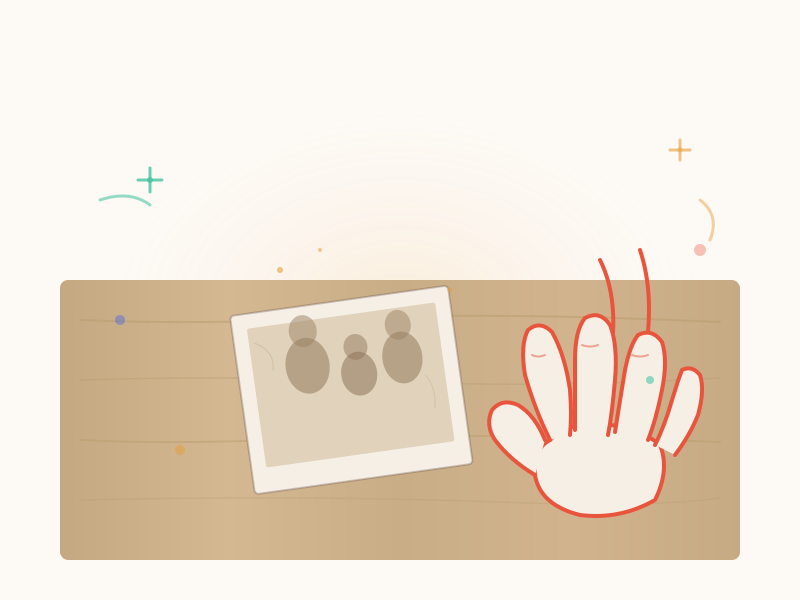
Documents, letters, and unexpected triggers
Old letters, report cards, newspaper clippings, certificates, receipts. These paper traces of a life often trigger memories that photographs miss. The formal language of a letter from a parent. The subjects listed on a school report. The date on a document that places your parent at a specific moment in history.
If your family has boxes of old papers, go through them together. Don't organize. Just look. Let your parent pick up items and react. Some will mean nothing. Others will unlock stories you've never heard.
Piggybacking on natural moments
Driving together and the side-by-side advantage
The best conversations often happen when nobody planned them. And one of the most reliable settings is a car.
When you sit side by side, facing the same direction, social pressure drops. There's no intense eye contact. Long pauses feel natural because you're both watching the road. The intimacy is there, but it's not confrontational.
Long drives to family gatherings, errands run together, trips to pick something up. These are opportunities. You don't need to announce that you want to talk about the past. You can let the conversation wander, and gently steer it when an opening appears.
"This road reminds me of the drive to Uncle Joe's house. Did you go there often as a kid?"
Cooking and the rhythm of shared tasks
Preparing a meal together creates similar conditions. Hands are busy. Eyes are on the task. The rhythm of chopping, stirring, measuring creates natural pauses and flows.
Ask your parent to teach you a family recipe. The teaching itself becomes a vehicle for stories. "Mom always added more garlic than the recipe said." "We only made this at Christmas because the ingredients were expensive." "Your grandmother learned this from her mother, who learned it from hers."
The stories attach to the actions. They emerge because the context calls them forward.
Family gatherings when stories surface organically
Holiday dinners, birthday parties, reunions. These gatherings often produce stories spontaneously, especially when multiple generations are present. Someone mentions a name, and suddenly three people are contributing different pieces of a memory.
Your role here is to listen actively and follow up later. If your aunt mentions something about your father's childhood, make a mental note. Bring it up the next time you're alone with him. "Aunt Mary mentioned you used to build forts in the backyard. What was that about?"
The gathering surfaces the material. The private conversation explores it.
News events and current topics as bridges to the past
A news story about a place your parent once lived. A documentary about an era they experienced. A reference to a historical event that shaped their generation. These present-day triggers create natural bridges to the past.
"Did you ever see anything like this when you lived in Detroit?" "What do you remember about when that happened?" "This reminds me of something you mentioned once."
The connection to current events makes the question feel less like an interview and more like a natural continuation of what you're both experiencing.
Questions that don't feel like questions
Statements that invite stories
The direct question puts your parent in the position of having to produce something. A statement invites them to respond without demanding it.
Compare these approaches:
| Direct question | Statement that invites |
|---|---|
| "What was your father like?" | "I've been thinking about Grandpa lately." |
| "Tell me about your childhood." | "I realized I don't know much about the house you grew up in." |
| "What did you want to be when you were young?" | "I wonder what you dreamed about when you were my age." |
| "How did you meet Mom?" | "I've always loved the story of how you two met." |
The statement creates an opening. Your parent can step through it or not. The pressure is lower. The response often comes more freely.
The "I've always wondered" approach
This phrase works remarkably well. "I've always wondered what it was like when you started your first job." "I've always wondered why we never visited Grandma's hometown." "I've always wondered what you thought when you first saw this house."
The phrase signals genuine curiosity without demanding an immediate, complete answer. It positions the question as something you've carried for a while, which flatters your parent and suggests the answer matters to you.
Sharing your own memories first
Reciprocity opens doors. Instead of asking your parent to share, share something yourself first.
"I was thinking about that summer we spent at the lake house. I must have been seven or eight. Do you remember that? What was happening in your life then?"
Your memory becomes the prompt. Your parent responds not to an abstract question but to a specific shared experience. And often, their response includes context you never knew.
Asking about others to hear about them
One of the most effective techniques: ask your parent about other people to learn about them indirectly.
"What was your mother like as a cook?" tells you about your grandmother, but it also reveals your parent's childhood kitchen, their relationship with food, their memories of being fed and cared for.
"What did your father do for fun?" tells you about your grandfather, but it also surfaces what your parent observed, admired, or resented.
"Who was your best friend growing up?" leads to stories about your parent's social world, their school, their neighborhood, their values.
The question about someone else feels safer. The stories that emerge are often more revealing than direct self-reflection would be.

Handling resistance and short answers
When "I don't remember" means something else
"I don't remember" is rarely a simple statement of fact. More often, it means one of several things:
- "I don't want to talk about this."
- "I don't think you'd be interested."
- "This is too painful to revisit."
- "I don't know where to start."
- "I actually don't remember, and I feel embarrassed about it."
Learning to distinguish between these requires attention to context and body language. Does your parent seem uncomfortable? Do they change the subject quickly? Do they give "I don't remember" as a blanket response, or only to certain topics?
When memory is genuinely faded, you can help by offering specifics. "Do you remember what school you went to?" "Was the house on a busy street or a quiet one?" Narrow questions can sometimes retrieve what broad ones cannot.
When the resistance is emotional, the approach must be gentler. Acknowledge the difficulty. "I understand if this is hard to talk about." Sometimes that acknowledgment itself opens a door.
Reading the signals to pause or push gently
Your parent's responses carry information beyond their words. A long pause before answering. A shift in posture. A change in voice. Eyes that look away or grow distant.
These signals tell you whether to continue or retreat. Pushing through genuine discomfort rarely produces good results. It can make your parent associate your questions with pressure, making future conversations harder.
But a gentle nudge can sometimes help. "You don't have to answer if you don't want to, but I've always been curious about this." The explicit permission to decline often paradoxically makes answering easier.
The follow-up that opens doors
When you get a short answer, resist the urge to immediately ask another question. Instead, respond to what you were given.
Your parent says: "We moved around a lot."
You could ask: "Why did you move so much?" But that might feel like interrogation.
Instead, try: "That must have been hard, making new friends all the time." Or: "I didn't know that. Where were some of the places you lived?"
The first response shows empathy. The second asks for specifics without demanding explanation. Both keep the door open without pushing through it.
Respecting boundaries while staying curious
Some topics will remain closed. Family secrets, traumatic experiences, sources of shame. Your parent has the right to keep these private, even from you.
Respecting this boundary doesn't mean abandoning curiosity. It means accepting that some stories may never be told, while remaining open to the possibility that they might be told later, differently, or partially.
You can say: "I understand if you don't want to talk about this. But if you ever do, I'd love to listen." Then let it go. Sometimes the permission to share, given without pressure, creates the conditions for sharing months or years later.
Building a rhythm over time
Why one long conversation rarely works
The fantasy is appealing: you sit down with your parent for an afternoon, recording device ready, and capture their entire life story. It almost never works this way.
Memory doesn't operate on demand. Your parent can't simply retrieve decades of experience in sequence because you've allocated three hours. The pressure of "the big interview" often produces less than a casual conversation over coffee.
More importantly, trust builds incrementally. Each small conversation where you listen well makes the next conversation easier. Your parent learns that you're genuinely interested, that you won't judge, that sharing with you feels good rather than exposing.
If you want a more structured interview approach, prepare to conduct it across multiple sessions, not one marathon.
The cumulative effect of small moments
Twenty brief conversations over two years will yield more than two long interviews. Each exchange adds pieces. Each piece connects to others. Patterns emerge. Gaps become visible and can be gently explored.
This approach also fits better into real life. You're not asking your parent to set aside a special day. You're incorporating questions into regular visits, phone calls, shared activities. The gathering of stories becomes woven into your relationship rather than a separate project.
Keeping light notes without being obvious
After conversations, take a few minutes to write down what you learned. Names, places, dates, stories, questions that arose. Keep these notes somewhere you'll find them before your next visit.
This practice serves multiple purposes. It helps you remember details that would otherwise fade. It shows you patterns and gaps in what you know. And it provides prompts for future conversations. "Last time you mentioned someone named Helen. Who was she?"
Don't take notes during conversations with your parent. The act of writing changes the dynamic, makes it feel like an interview. Note afterward, privately.
How stories build on stories
Memory is associative. One story triggers another. A name mentioned in passing connects to a different era. A place reminds your parent of someone they haven't thought about in decades.
This is why ongoing conversation works better than single interviews. Each exchange creates new hooks for memory. "Remember when you told me about the summer you worked at the cannery? What happened after that?"
The stories build on each other, each one making the next one more accessible.
When parents actively resist sharing
Understanding the reasons behind silence
Some parents genuinely don't want to talk about their past. Understanding why can help you respond with compassion rather than frustration.
They may be protecting you from difficult truths. They may be protecting themselves from reliving pain. They may feel shame about choices they made. They may have promised someone else to keep a secret. They may simply be private people who find self-disclosure uncomfortable.
None of these reasons mean they don't love you or don't want connection. They mean the particular kind of connection you're seeking feels threatening in ways you may not fully understand.
Trauma, shame, and protected memories
War, abuse, addiction, poverty, immigration under duress, loss of children, failed marriages. Many lives contain chapters that remain closed because opening them would cost too much.
If you sense that your parent's silence covers something painful, tread carefully. Pushing for details can feel like violation. Respecting the boundary shows love.
You can acknowledge the existence of difficult territory without demanding entry. "I know there are things from that time you don't want to talk about. That's okay. I just want you to know I'm here if you ever do."
For conversations with aging parents in particular, the urgency you feel must be balanced against their right to protect themselves.
The letter or recording as an alternative
Some parents find it easier to write than to speak. Others find it easier to speak into a device alone than to face a listening family member.
You might offer alternatives. "Would you ever consider writing down some of your memories? Just for yourself, or for me to read someday?" "Would you be willing to record yourself talking about the old days? You could do it whenever you want, alone, and I'd listen later."
Autobiographai works this way, guiding people through their memories decade by decade with questions they can answer in their own time, without the pressure of a family member watching. Sometimes a neutral guide makes sharing easier.
Accepting what may never be told
Some stories will remain untold. This is not a failure. It is a reality of human relationships.
Your parent's life is their own. The stories they choose to share are gifts. The stories they choose to keep are theirs by right.
What you can do is create conditions where sharing feels safe, ask in ways that don't demand, listen well when stories come, and accept with grace when they don't. The relationship matters more than the information. Your parent knowing you cared enough to ask, even if they couldn't answer, is itself a form of transmission.
For specific questions to ask your parents, remember that the goal isn't extraction. It's connection. The questions are invitations. Some will be declined. The invitation itself still matters.
If your parent is a father who tends toward silence, getting fathers to open up often requires patience across months rather than pressure in moments. If your parent is a mother, questions that work well with mothers may need different framing. Either way, the principle holds: create conditions, extend invitations, accept what comes.
And while you can, consider recording their voice while you can. Even fragments, even half-stories, even the sound of their laughter at a memory they won't quite explain. These recordings become treasures.
Related articles
- Theme
Questions to ask your parents
Most people assume they have time. Time to sit down with their parents over coffee, time to ask about the stories they've only half-heard, time to finally recor…
100 questions to ask your parents
You've been meaning to do this for years. Sit down with your parents, ask the real questions, capture the stories before they fade. But every time the moment ar…
Questions to ask your mother
Most people believe they know their mother. They grew up watching her, listening to her voice, absorbing her habits. But ask yourself: how much do you actually …
Questions to ask your dad
Most people who want to ask their father about his life face the same frustrating pattern: you ask a question, he gives a three-word answer, and the conversatio…
How to interview parents about their life
Most families carry stories that will disappear within a generation. The details of how your grandparents survived the war, what your mother dreamed of becoming…
Ready to write your autobiography?
You've tried before. You sat down with your mother, maybe during a quiet afternoon, and asked her how to ask parents about their past without making it feel lik…
Start